Working with an Army Corp of Engineers Engineer Research and Development Center (ACE ERDC) funded project while in the Lopez laboratory, research scientist Lauren Krausfeldt has generated significant DNA sequence or “-omics” (comprehensive genomic) datasets that will serve multiple efforts and scientists working in the Lake O ecosystem. The second bloom research paper from our work now appears in the international journal, Microbiology Spectrum, describing the diverse bacterial communities that can support HABs, and the dynamics of different cyanobacteria and their pathways including bloom forming Microcystis aeroginosa species. For more details please visit – https://journals.asm.org/doi/full/10.1128/spectrum.01369-24
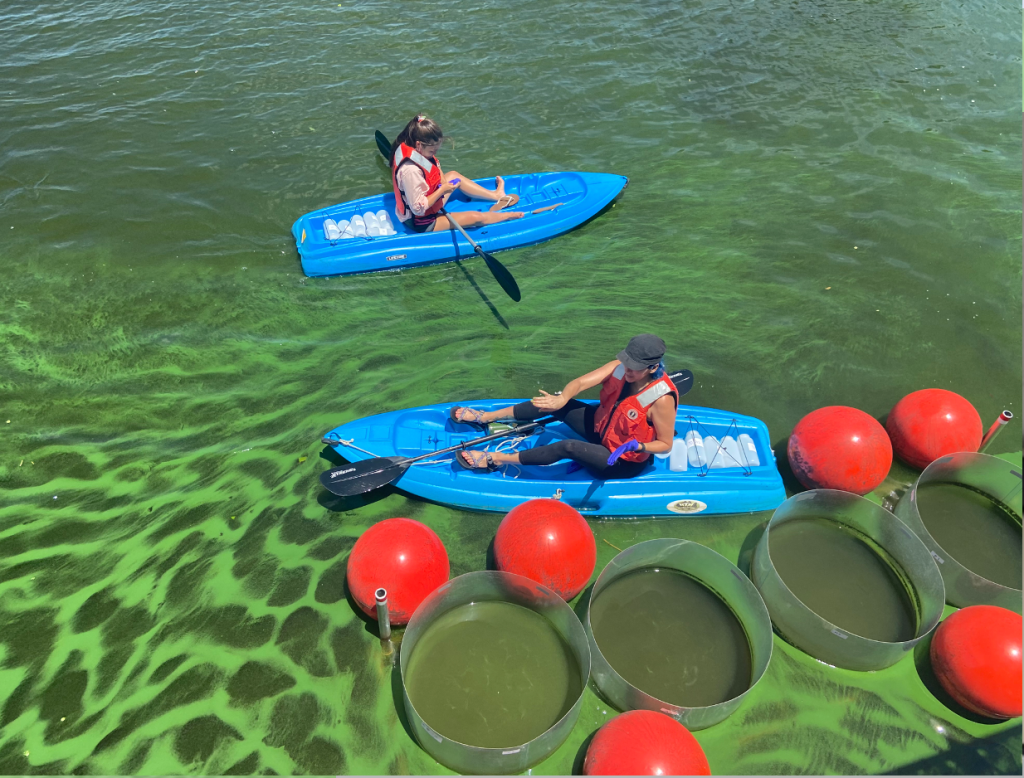
The research team included NSU professor Robert Smith and multiple graduate student volunteers, the US Geological Society (USGS), Dr. Barry Rosen and Dr. Hidetoshi Urakawa from Florida Gulf Coast University (FGCU). The artificial mesocosm experiments at Franklin Lock were based on taking Calosoosahatchee River water and placing it into large replicate cylinders, which essentially creates a closed system for systematic study. This allowed the team to add various nutrient supplements to the natural river water microbial communities, and monitor the effects physiologically, which genes were activated, but without degrading the surrounding habitats. For many years, nutrients such as nitrates, phosphates or ammonia can flow into Lake O from rivers or nearby farms. The NSU team found that urea, a common component of most fertilizers had strong effect in maintaining blooms. By applying extensive DNA and RNA sequencing and other analytical methods to these samples, the team has characterized HAB communities in their natural and artificial environments. The studies provide deep insight into the factors that drive HABs without having to culture the mostly unculturable microbes in the lab. Dr. Krausfeldt carried out the bulk of Lake O -omics analyses and now conducts research for the National Institutes of Health.
 Lopez Lab @ NSU