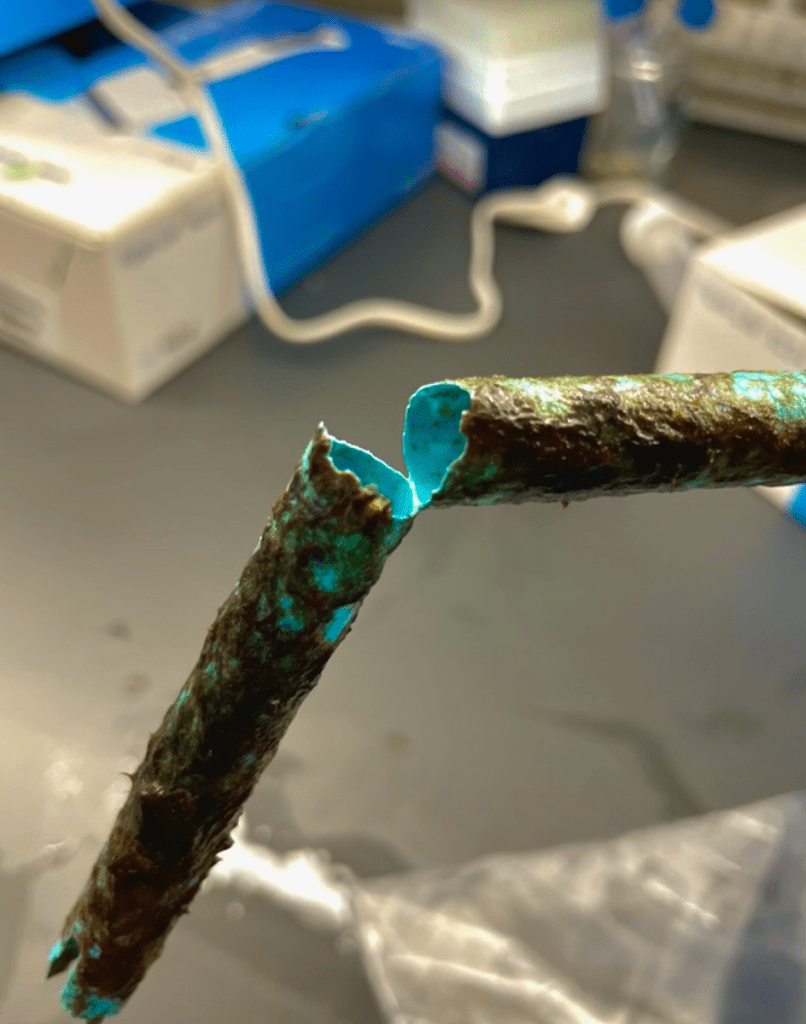
Plastic pollution represents a huge environmental problem, and drinking straws are a major component of such pollution. It is estimated that 8.3 billion plastic straws contaminate the world’s beaches. Fortunately, there is a burgeoning market for biodegradable polymers that may ultimately reduce marine plastic pollution. Relatedly, light blue Phade drinking straws made of biodegradable polyhydroxyalkanoate (PHA) are now commonly found in restaurants and bars. PHA is one of only two biopolymers that degrade well in the marine environment. Our MMG laboratory has collaborated with Dr. Kirk Dotson, Broward Reef Discovery Center (RDC) founder and engineer, to study the biological degradation of polyhydroxyalkanoate (PHA) drinking straws. These straws were first used to construct “coral fortresses” that protect juvenile hard corals from parrot fish predation in a Nova Southeastern University MS thesis by Kyle Pisano. Because PHA stems from biological origins based on canola oil and thus can be degraded naturally, we asked what types of microbes break down PHA straws in the marine environment. This project has now been published in the Journal of Environmental Chemical Engineering as the paper “ Degradation of Polyhydroxyalkanoate (PHA) Drinking Straws at an Ocean Shoreline”. This is the first biophysical characterization of degradation of any 3D object made of PHA
The fifteen-week experiment had two intertwined components: microbial analyses and mass loss assessments. PHA degrades because some types of bacteria eat away at the plastic’s exposed surfaces. These favorable bacterial strains such as Anderseniella, Labrenzia, Limibaculum do not exist in all marine environments, so identifying them was key to establishing the efficacy of PHA degradation at any given physical location. The 16S rRNA sequences are available at NCBI under BioProject PRJNA1290816.
Additionally, precise mathematical modeling of the geometry changes during mass loss was critical for defining the lifetime of PHA straws in the marine environment. Factors like the amount of degradation inside vs outside of the straws can played a major role in the predicted degradation rate. The paper addressed all of these critical issues.
Nova Southeastern University (NSU) Master of Science student Emma Gellman conducted the novel microbial analyses at the Guy Harvey Oceanographic Center to define the key bacterial strains and their abundance as a function of time. NSU doctoral student Kyle Pisano and Kirk Dotson, founder of the RDC, addressed mass loss as a function of time and developed a unique model of degradation for hollow cylinders, such as drinking straws. Patrick Roman, a professor at Florida International University, conducted scanning electron microscopy, to create images of the microbes on the degrading straws and associated pitting of the plastic surface. This pivotal study of temporal and spatial variability of microbes and geometry appears to be the first of its kind in the literature.
 Lopez Lab @ NSU